
Choosing between a pit weighbridge and an above-ground deck is an engineering decision, not a preference. The right design depends on your site space, soil and drainage, traffic flow, safety rules, verification path, and lifetime operating costs. This guide gives you a practical, South Africa-specific framework to pick a design that measures accurately, runs safely, and remains cost-effective over its lifecycle.
Provenance: aligned with existing Clover Scales thought leadership on weighbridges and modern weighing systems.
Clover – Why Weighbridges Matter
Clover – Precision in Motion
Quick Definitions
- Pit weighbridge: The deck sits level with finished ground. Most mechanical parts are in a pit formed by reinforced concrete walls. Vehicles approach on a flat plane.
- Above-ground weighbridge: A raised steel or concrete deck installed on piers or a raft with entry and exit ramps.
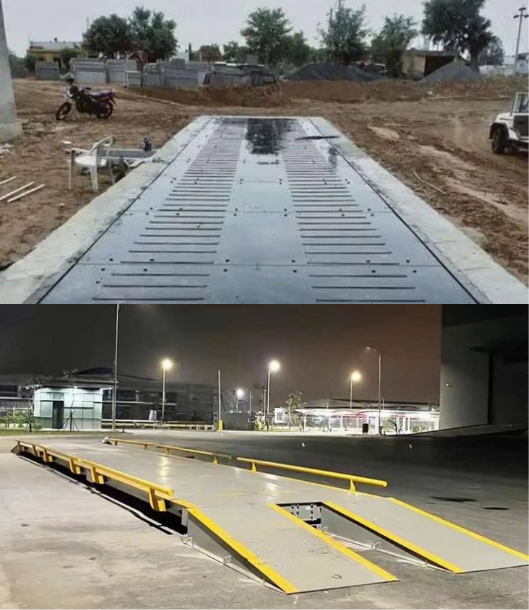
The Decision Framework
- Space & traffic: Turning circles, queue length, one-way vs two-way flow, and approach grades.
- Ground & water: Soil bearing capacity, water table, stormwater run-off, and nearby services.
- Throughput & safety: Vehicles per hour, single-vehicle-on-deck control, slip and collision risk.
- Verification & accuracy: Legal-for-trade checks, test mass access, corner testing, and indicator integrity.
- Build & lifetime cost: Civils, steelwork, ramps, drainage, maintenance, and downtime.
- Future upgrades: Cameras, tag systems, traffic lights, kiosks, and software integration.
Site Criteria: What Favors Each Design
When a pit design fits best
- Tight yards with limited approach space. Level access removes the need for long ramps.
- Bidirectional traffic in narrow lanes. Flush deck simplifies in-out flows.
- High winds or dust risk. Lower profile can reduce debris build-up around the deck.
- Aesthetics or historic sites. Flush installation has minimal visual impact.
When above-ground is smarter
- Challenging groundwater. You avoid a permanent hole that can flood or buoy.
- Expansive or reactive soils. Easier to isolate piers and control movement.
- Fast installation and relocation. Ramps and modular decks reduce civil complexity.
- Easy inspection and service. Junction boxes, restraints and load cells are accessible without confined-space entry.
Civils & Foundations: Do’s and Don’ts
Pit weighbridge civils
- Drainage first. Provide a graded pit floor to a trapped sump with robust covers. Keep conduits above flood level and specify corrosion-resistant fixtures.
- Wall design. Reinforce for lateral soil pressure and traffic impact. Include drip details along the deck line to keep water out.
- Access. Plan safe means of entry for service without breaching safety rules.
Above-ground civils
- Foundations. Use isolated piers or a raft per the deck supplier’s loading plan. Verify soil bearing with a geotech report.
- Ramps. Set approach grade at a practical slope for loaded vehicles and wet conditions. Use non-slip surfaces and bollards to protect edges.
- Cable ways. Keep conduits segregated from power, with proper glands and slack loops for thermal movement.
Field practices here complement Clover’s existing guidance on industrial weighing layouts and long-term efficiency.
Clover – Precision in Motion
Drainage & Water Management
- Pits need reliable pumping and inspection routines. A blocked sump is the fastest path to load-cell failure. Add leaf guards, a debris basket, and an alarmed float switch.
- Above-ground installs shed water naturally. Keep ramp run-off away from junction boxes, and seal conduit penetrations to stop capillary ingress.
- Both types: Maintain clear fall around the bridge, seal cable entries, and spec IP-rated junction boxes appropriate to your environment.
Access, Queuing & Safety
- Single-vehicle-on-deck control. Traffic lights and boom gates prevent double weighing and reduce disputes.
- Approach alignment. A flush pit can simplify alignment in tight yards, but a raised deck with well-designed ramps and bollards can be just as safe.
- Confined space: Pits introduce confined-space hazards and permit requirements for some tasks. Above-ground decks avoid most of this.
- Slips and collisions: Grade, surface finish, nighttime visibility, and curb protection matter more than the deck type. Add high-grip surfaces and lighting on approaches.
These measures align with Clover’s broader advice on automation and safe, controlled workflows.
Clover – Future-Ready Weighing
Accuracy, Verification & Calibration (SA context)
For instruments used in trade in South Africa:
- Legal verification: Plan at least every two years under NRCS Legal Metrology.
- Calibration: Set intervals based on throughput, environment and risk, using a SANAS-accredited laboratory (ISO/IEC 17025).
- Practical notes:
- Pits can ease test-mass handling thanks to level access, but confined-space rules slow some tasks.
- Above-ground decks make corner testing and underside checks simpler.
- Add alibi memory and secure time-stamps on indicators to keep clean audit trails.
Clover has covered the why and how of ongoing calibration in previous content; this article applies the same discipline at the design stage.
Clover – Beyond the Scale
Clover – Scale Calibration
Total Cost of Ownership (TCO)
Capex
- Pit: Higher civils cost, sump hardware, more steel and concrete.
- Above-ground: Lower civils, additional ramp steel and surfacing.
Opex
- Pit: Pump maintenance, debris removal, confined-space procedures, corrosion control.
- Above-ground: Ramp wear and resurfacing over time, regular restraint and cabling checks.
Downtime
- Pit: Water ingress or sump failure can stop operations.
- Above-ground: Faster fault isolation and component swaps reduce outage duration.
Resale/relocation
- Pit: Fixed to civils.
- Above-ground: Modular and easier to relocate or expand.
Decision Examples
- Small logistics yard with tight geometry and strict turnarounds: Pit works if groundwater risk is low and you can maintain the sump.
- High-rainfall site or high water table: Above-ground avoids chronic flooding risk and reduces long-term corrosion costs.
- Temporary or seasonal operation: Above-ground with modular ramps to control capex and preserve relocation options.
- High-security, high-volume gate: Either design works, but pair with traffic control, cameras and tag systems to enforce single-vehicle-on-deck discipline.
Clover – Future-Ready Weighing
Checklist: Pit vs Above-Ground
- Space and queue layout confirmed
- Geotech and water table assessed
- Drainage and power isolation designed
- Test-mass access and corner testing method planned
- Safety controls specified (lights, booms, cameras, signage)
- Verification and calibration cadence budgeted (NRCS/SANAS)
- Service access, spares and downtime modelled
- Future upgrades planned (software, kiosks, analytics)
Conclusion
There is no universal best weighbridge. The right choice follows your site data, traffic plan, water and soil conditions, and lifecycle model. If you balance civils, drainage, access control and compliance upfront, the deck type becomes an outcome of good engineering rather than a gamble.Call us to book a site assessment. We’ll map your traffic flows, water risks and verification path, then recommend the design that delivers accurate weighing, safe operations and the lowest lifetime cost.